
Generate funder reports 4x faster.
Donara structures all your NGO's raw data to make it meaningful, then generates polished, verifiable reports your funders and stakeholders will trust. It is grant management software built for reporting, not another database to maintain.
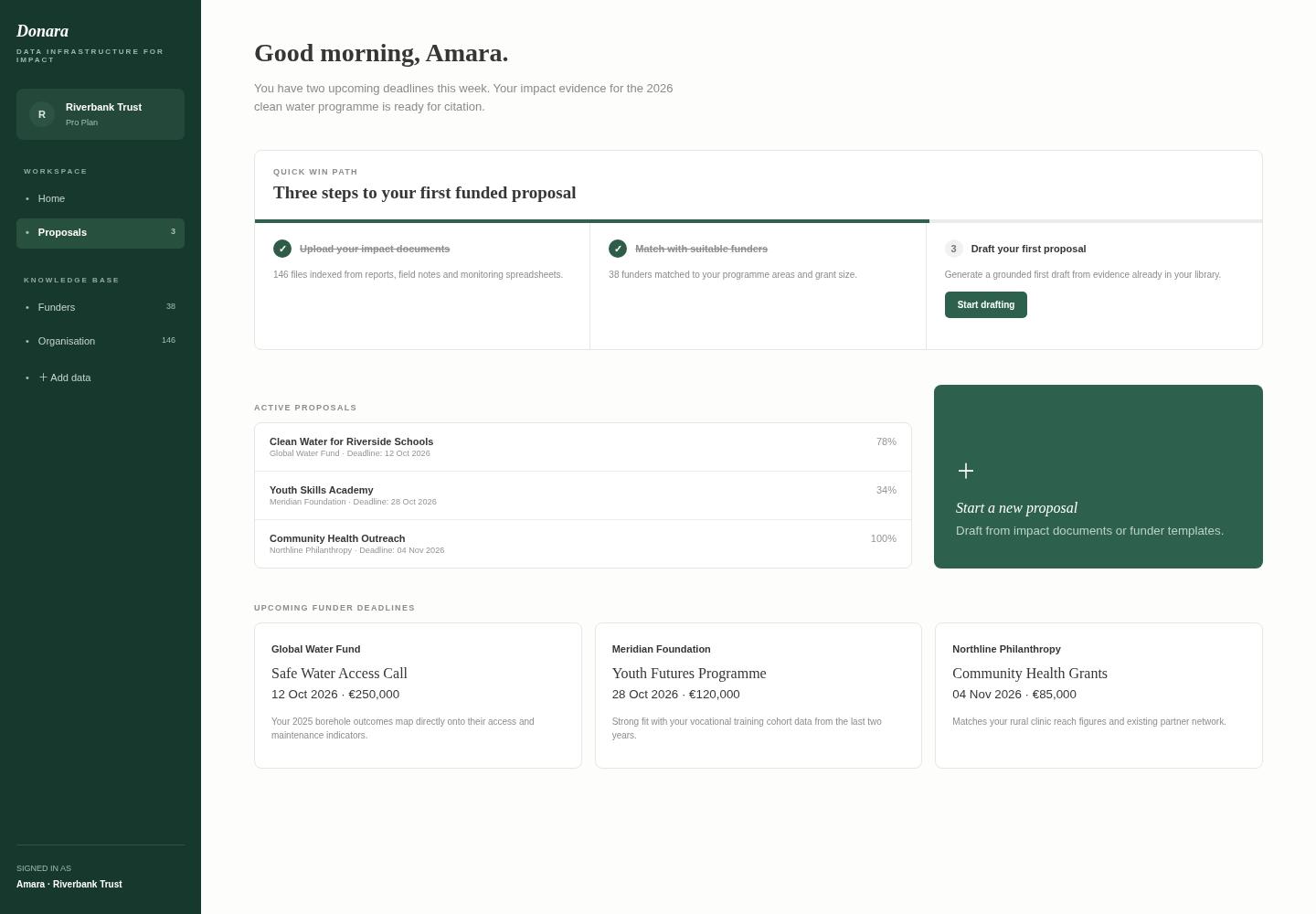
Most NGOs already have valuable data. What they lack is structure.
Most NGOs collect valuable data, but it lives in spreadsheets, field notes, and old PDFs with no consistent structure. That makes it hard to analyse, harder to report on, and nearly impossible to verify.
- Data is scattered across formats and systems, making it almost impossible to get a clear picture of your own impact.
- Every new report means hours of manual reformatting, copy-pasting, and chasing down consistent numbers.
- Funders want evidence-based, verifiable reports, but unstructured data can't support that level of rigour.
- Sensitive data is not protected in public AI models. Donara uses local data storage and enterprise-licensed LLMs, so your information stays private and secure.
"We have the impact data, but telling the story through fragmented data is challenging. Every report feels like starting from zero."Programme Lead at a partner NGO
Four steps. One seamless process.
From raw files to polished, verifiable reports: here's how Donara turns your data into something funders trust.
Share whatever you have: raw exports, old reports, field data. We accept .xlsx, .csv, .pdf, .docx and more. No preparation needed.
Select a grant from our funder library, or add your own with custom funder requirements. Then share any additional context to tailor the output to your needs.
We organise your raw files into a consistent, structured format, making your data comparable over time and ready for accurate reporting.
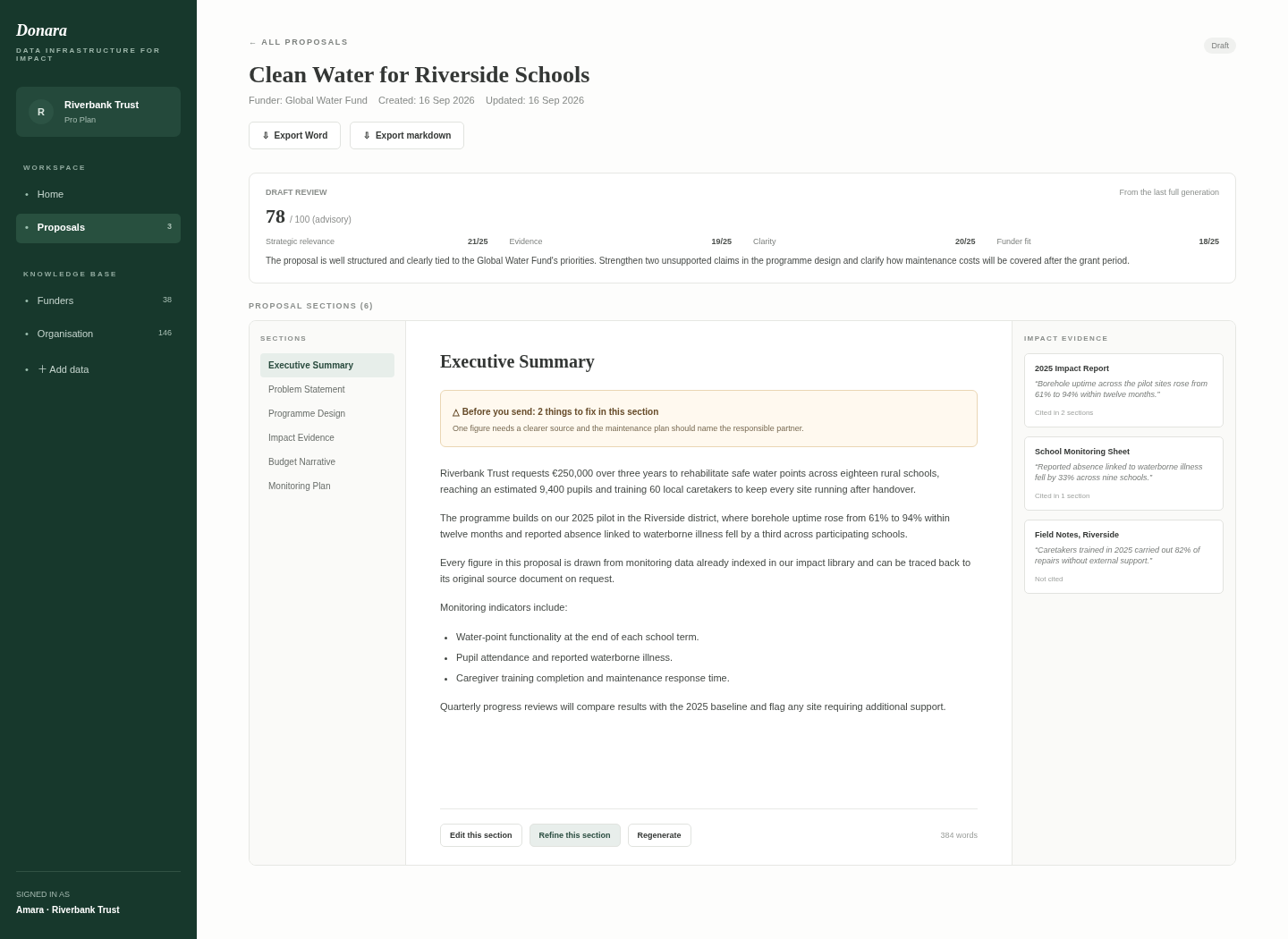
Donara produces polished, professional reports tailored to your audience. Every figure is traceable, giving funders confidence to act.
Documents that work for every audience.
One structured dataset. Multiple outputs. Each tailored to who's reading it and what they need to see.
Reports
Narrative-ready reports built directly from your structured data: evidence-based, compelling, and formatted to each funder's framework.
Funder Briefs
Concise impact summaries that communicate your results clearly to private funders, foundations, and institutional partners.
Government Reports
Formal, verifiable documents that meet the standards of government and public-sector funders. Every claim backed by data.
Internal Reports
Clear internal documents for boards, leadership, and teams, giving everyone a consistent view of what's working.
Progress Updates
Regular funder updates generated from your latest data: consistent, on-brand, and always on time.
Verifiable by Design
Every figure in every report traces back to your structured data, so you can stand behind what you submit with full confidence.
Simple plans. Built to grow with you.
Start free. Upgrade when you're ready for unlimited reports and full funder library access.
Test Donara on a live project.
- 1 free report credit (one-time)
- Core data structuring
For small NGOs with occasional reporting needs.
- 1 report per month
- Core data structuring
- Standard export (Word / PDF)
Ideal for active M&E teams and mid-sized NGOs.
- Up to 4 reports per month
- Advanced data structuring & matching
- Unlimited free revisions per project
- Flexible €35 top-up per extra report
For high-volume issuers and large multi-funder consortia.
- 5+ reports & custom volume
- Dedicated AI data engineering
- Custom funder profiles & SLA
Unlimited iterations included
A 'Report Credit' is counted per unique project, not per AI click. Once you start a report, you can give the AI feedback, rewrite sections, and regenerate the document as many times as you need within 7 days until it is 100% perfect. No hidden fees for polishing your drafts.
Questions NGOs ask us.
How long does grant reporting actually take an NGO?
Our benchmark of the Dutch sector found it ranges from 8 to 12 hours per grant at the smallest organisations to between 25 and 40 hours at the largest. For a mid-sized NGO reporting to several funders a year, that works out at roughly €10,780 to €15,400 in staff time annually. Most of it goes on finding and reformatting data the organisation already holds.
How is this different from using ChatGPT to write our report?
A general AI tool writes from whatever you paste into it, so the report is only as good as the inputs you assembled by hand. Donara connects to your data first, structures it against the indicators your funder asks for, and drafts from that. Every figure in the output traces back to a source document, which is the part a funder can check.
Will funders accept a report drafted with AI?
Most funders have no written policy yet. One 2024 survey found 61 per cent of nonprofits already using AI in fundraising while only 15 per cent of foundations had published any guidance for applicants. What programme officers consistently say they react badly to is generic language that could describe any organisation. That risk comes from drafting without evidence, which is why Donara drafts from your own data rather than from a prompt.
Do we still need to review what Donara produces?
Yes. Our own benchmark found first drafts typically need 20 to 30 per cent human editing, and we would be sceptical of anyone claiming otherwise. What changes is where your time goes: less of it on assembling and reformatting data, more on the judgement and narrative only your team can supply.
Can Donara connect to the systems we already use?
Yes. You can upload files directly as .xlsx, .csv, .pdf or .docx, or connect Google Drive or SharePoint so Donara reads from where your documents already live. Field teams can also send voice notes, photos and messages over WhatsApp, which Donara turns into structured evidence.
Is our data used to train AI models?
No. Donara uses local data storage and enterprise-licensed language models, so your organisation's data is not used to train public models. This tends to be the first question a funder's compliance team asks, so it is worth having the answer in writing.
What does Donara cost?
There is a free tier with one report credit. Starter is €49 a month for one report a month. Growth is €149 a month for up to four reports, or €119 a month billed annually, with additional reports at €35 each. Organisations needing five or more reports a month move to custom pricing.
What counts as one report?
A report credit is counted per project, not per AI generation. Once you start a report you can give feedback, rewrite sections and regenerate the document as many times as you need within seven days, at no extra cost.
How long does it take to get started?
You can upload a file and generate a report without any setup, which is what the free credit is for. The longer piece of work is structuring your historical data, and that pays off from the second report onward, because the structure carries over instead of being rebuilt each time.
Do we need someone technical to use it?
No. If your team can work with spreadsheets and documents, they can use Donara. The structuring work happens on Donara's side, so it is built for programme and grants staff rather than data specialists.
Is Donara grant management software?
It covers the reporting half of grant management. Traditional grant management software tracks deadlines, budgets and pipeline. Donara starts from the data your organisation already holds, structures it against funder indicators, and produces the applications and reports themselves, with every figure traceable to a source document. Many NGOs run it alongside a grants tracker or a CRM rather than instead of one.
Ready to make every report count?
Donara helps NGOs everywhere structure their data and generate professional, verifiable reports. Get in touch to see how it works for your organisation.
Get in TouchLet's talk.
Have questions or want to see a live demo? Reach out directly. We'd love to hear from you.